
Identify the Alexander Custodian
The same person can move from Pulaski detention to IDOC or federal custody while several systems show different dates. Record the agency, case number, booking or IDOC identifier, and time checked. A date from one custodian describes only that custody stage. Following the movement record prevents a transfer date from being reported as a return to the community.
Alexander County Projected Release Dates
IDOC uses three date labels that must stay separate. Projected Parole Date is forward-looking and concerns an expected prison-to-community or other eligible status transition. Last Paroled Date is historical. Projected Discharge Date estimates the end of the sentence or supervision. A person can leave prison, begin mandatory supervised release, and retain a future discharge date.
An actual release is an accomplished event recorded by the custodian. For an Alexander detainee physically held in Pulaski County Detention Center, that record should include the date, time, and authority for discharge or transfer. A court order may authorize release before jail staff complete identity checks, other-hold review, property return, and physical exit.
- Projected Parole Date
- IDOC’s expected prison-exit field, not proof of a past release.
- Last Paroled Date
- A historical state field that can support a past prison exit.
- Projected Discharge Date
- The estimated end of the sentence or supervision term.
- Mittimus
- The court commitment document used to carry the sentence into custody records.
- Detainer
- A notice that another authority may seek custody or action.
Find Alexander County Release Dates
Begin with the custody system. The IDOC search does not cover every person held locally. A misdemeanor, dismissal, pretrial release, or county sentence may never create an IDOC record. Conversely, a Pulaski transfer to IDOC is a jail release but not community release.
- Check the Alexander Circuit Court case for the custody order, disposition, sentence, mittimus, amended order, and awarded credit.
- Ask Pulaski County Detention Center for the jail calculation and release authority if the sentence is local.
- For a state commitment, open the IDOC offender search and use last name, IDOC number, or birth date.
- Compare IDOC number, birth date, sentencing county, offense, and mittimus before trusting the detail result.
- Record each displayed date by its exact label and the date checked. Verify the accomplished event with the record creator.
The Alexander County Circuit Clerk’s case route can show a release order, sentence credit, probation, or later amendment. Pulaski holds the physical jail exit record. IDOC holds the state sentence calculation. These records may fit together even when their timestamps differ.
Alexander County IDOC Date Fields
The legacy IDOC form accepts Last Name, IDOC Number, and Birthdate. A detail result commonly includes Offender Status, Location, Admission Date, Parent Institution, Projected Parole Date, Last Paroled Date, Projected Discharge Date, and a sentence table. The County and Mittimus fields help link the state result to an Alexander case.
| Field | Proper reading |
|---|---|
| Offender Status | Current state-system label when checked |
| Location | Facility or community-related location shown by IDOC |
| Projected Parole Date | Expected transition, subject to change |
| Last Paroled Date | Past event, if populated |
| Projected Discharge Date | Estimated sentence or supervision end |
| County and Mittimus | Connection to the sentencing case |
Fields can be blank or withheld. The public search is a locator, not the full calculation file. IDOC Directive 01.07.110 identifies sentence-calculation sheets, sentence-credit revocation and restoration cards, release checklists, parole packets, notices, detainers, and release packets as master-file components.
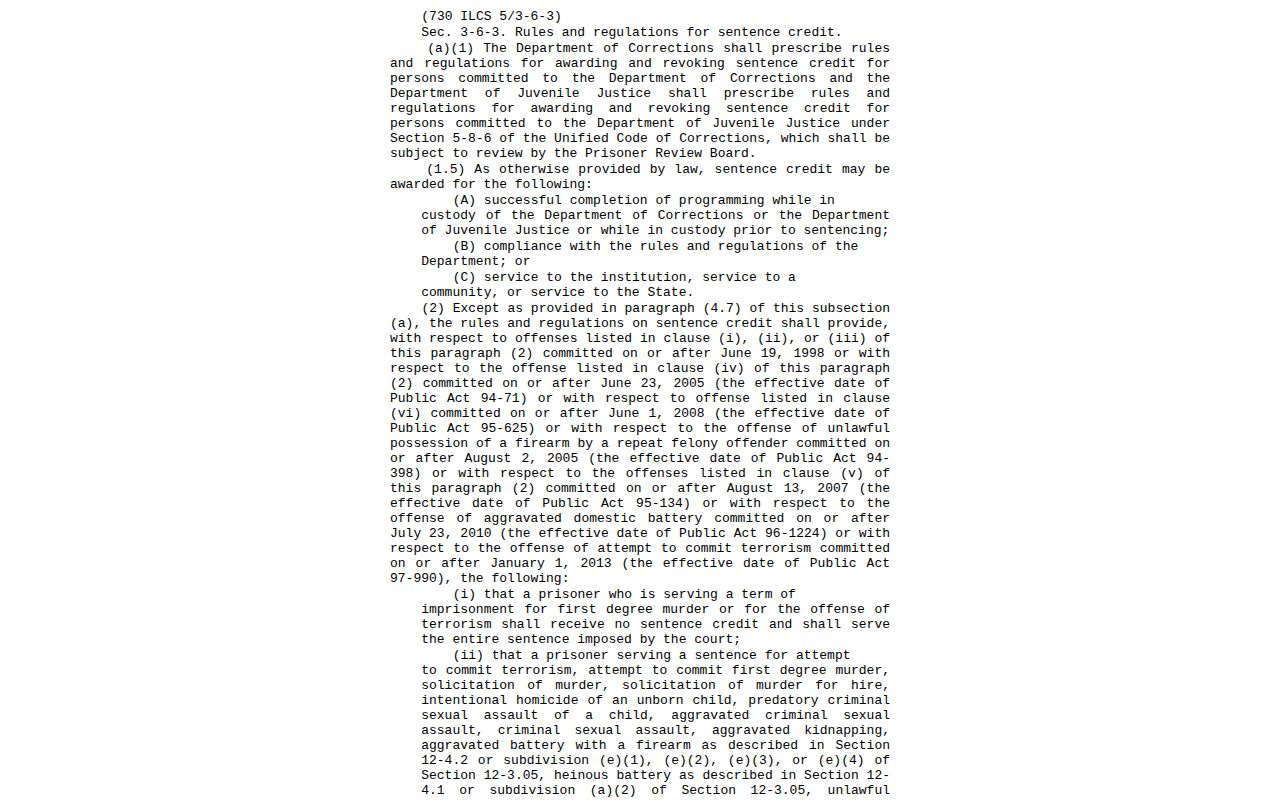
The official Illinois sentence-credit statute shows why one generic release-date formula is unsafe.
Alexander County Sentence Credit
Illinois does not have one universal “day-for-day” rule. Under 730 ILCS 5/3-6-3, the service and credit rule depends on the actual conviction, offense date, sentence, and exclusions. The statute contains categories that require 100 percent, about 85 percent, or 75 percent service, as well as other credit and program-credit provisions.
Truth in sentencing is best understood as a limit on credit for specified offenses. It is not a blanket 85 percent rule. Never choose a percentage from the arrest charge because the conviction can differ. Consecutive terms, concurrent terms, presentence credit, and later amendments also affect the calculation.
Alexander County Jail Calculations
A county jail sentence needs the commitment order, the jail’s credit calculation, and any rule that applies to that sentence. No public Pulaski-specific good-time policy was verified. The responsible path is to ask Pulaski and the Alexander court for the actual records rather than assume the IDOC formula applies.
A pretrial detainee has no sentence-based release date. The next event may depend on a court hearing, pretrial order, dismissal, plea, other hold, or transfer. The current roster can show that the person remains displayed, but it cannot predict when the judge or another agency will act.
A request may seek the booking sheet, movement history, commitment order, credit calculation, release screen, completed release date and time, authority, and destination. Ask for existing records and accept lawful redaction. The Alexander case search is useful access, while a certified court copy must come from the Circuit Clerk.
Why Alexander County Dates Change
Projection is an active calculation. The underlying term may remain the same while credits, orders, or custody plans change. Detainers can alter destination without changing the arithmetic date.
| Factor | Possible effect | Record to check |
|---|---|---|
| Presentence credit correction | Moves the calculated service point | Court order and calculation sheet |
| Consecutive or concurrent terms | Changes how sentences combine | Mittimus and IDOC calculation |
| Earned or program credit | May advance an eligible projection | IDOC credit record |
| Disciplinary revocation or restoration | May delay or restore time | Credit revocation/restoration card |
| Amended court order | Corrects sentence or custody credit | Amended mittimus |
| Detainer or transfer plan | Changes where the person goes | Detainer and movement record |
Legal changes and recalculation can also affect a date. Record the access date each time a projected field is quoted. Do not silently replace an older projection with a new one.
Alexander County MSR Dates
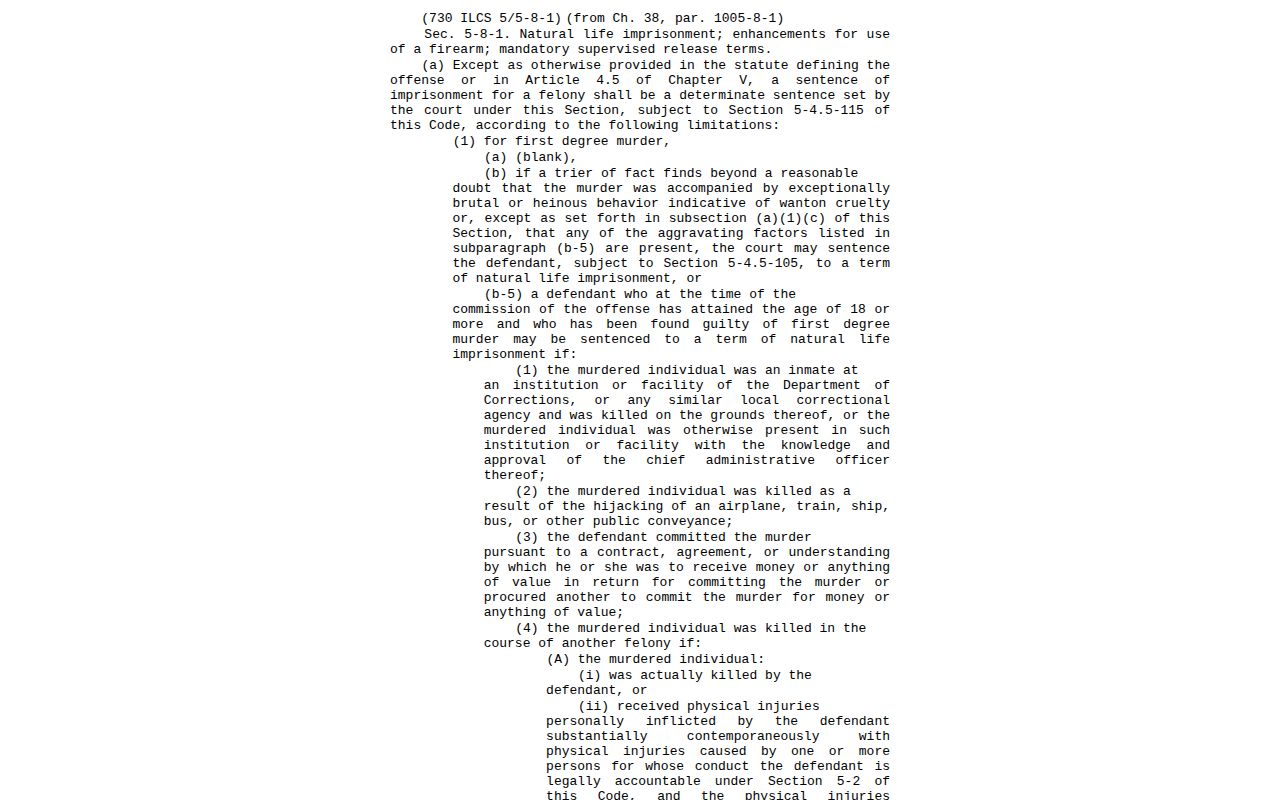
Under 730 ILCS 5/5-8-1(d), leaving prison may begin mandatory supervised release. That is why a past state prison exit and a future Projected Discharge Date can coexist. The person may be outside prison but still subject to IDOC community supervision.
Use the phrases “expected prison exit,” “actual past prison exit,” and “sentence or supervision end.” Each points to a different record. The Alexander County parole and probation page explains the state and county supervision split.
The official Illinois MSR statute provides the legal context for a future discharge after prison release.
Confirm Alexander County Release
A future date should be followed by an actual event source. For an IDOC prisoner, check Offender Status, Location, and Last Paroled Date after the projection passes. For a Pulaski detainee, obtain the completed release or transfer entry. Illinois VINE can provide notice of a custody change, but its event still needs interpretation.
Register before release when possible through the VINELink Release Check. A release alert from one agency may precede admission to another. If the record says transfer, continue with the receiving system. If dates conflict, quote each source and ask the creator to explain the sequence.
For a formal IDOC check, request the records behind the display. Directive 01.07.211 identifies release date, community status, projected discharge date, committing county, mittimus number, and supervision-office data in department release material. Directive 01.07.110 identifies the calculation sheet, credit records, release checklist, parole packet, notices, detainers, and photos in the master file. These records can explain a changed projection that the public result cannot.
For a local sentence, request the Alexander sentencing and credit orders, Pulaski's jail calculation, and the completed release or transfer entry. If a name search fails, supply the booking number, case number, and alternate spelling. A movement history may show a Pulaski transfer followed by IDOC admission. That chain can be consistent even though neither event proves community release.
Never estimate from the sentence length in a news item or charge record. The conviction, presentence credit, later orders, and statutory category control. Copy a projected field with its exact label and access date. When certainty matters, the calculation record and accomplished exit entry should support the conclusion together.